
Exciting Trends Shaping the Future of Youth Hockey
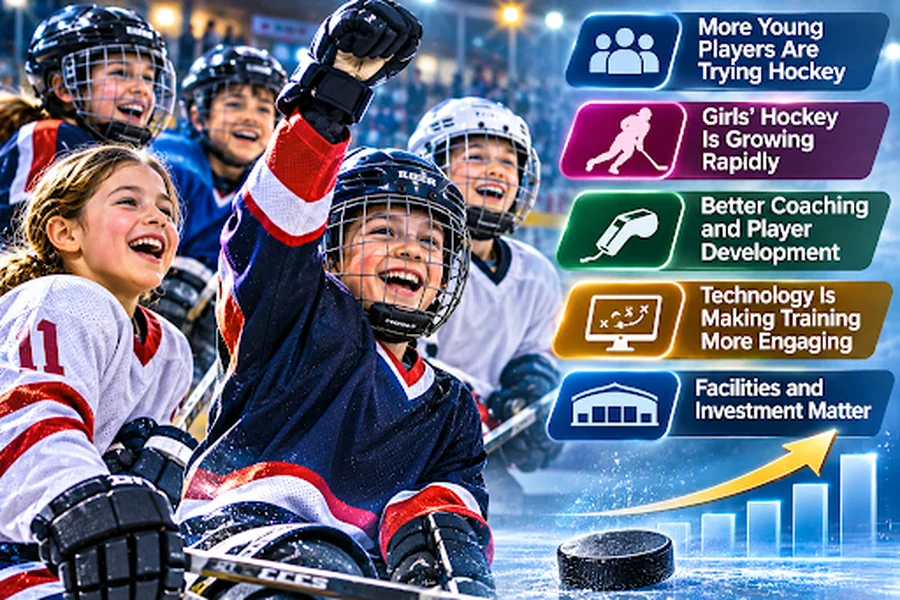
Youth hockey is in a great time of expansion and innovation. In the United States and Canada, more families are becoming aware of the sport through beginner’s programs, community efforts, better coaching and more availability of facilities. Concurrently, technology and new development models are assisting young players to improve at a quicker rate and also to enjoy the game in much more intriguing means.
This positive trend is further strengthened by the recent participation numbers. USA Hockey and NHL and NHLPA-supported Learn to Play and First Shift hockey programs reached an all-time high of 586,002 registered players in 2025-26 and introduced more than 43,000 boys and girls to hockey.
More Young Players Are Trying Hockey
The one thing that is good is that there are more introductory programs. Hockey is becoming more accessible to families who have felt it was difficult or costly to get into.Families who may have previously thought hockey was difficult or expensive may have more opportunities to try it before committing to the sport.
Over 10,000 children participated on more than 230 rinks nationwide during USA Hockey’s March 2026 Try Hockey For Free Day, which is the highest participation since 2019.
These programs are important because they allow children to have a frivolous experience with skating, equipment, coaching, and team in a low pressure environment. The better the pathway into the first-time hockey experience, the better the pathway to the pathway into the next phase of recreational and competitive hockey can be.
Girls’ Hockey Is Growing Rapidly
An additional promising development is the increasing opportunities for girls. By the 2025-26 season USA Hockey had more than 100,000 registered girl players, ending the season with 103,324 players.
The NHL and the NHLPA also noted good growth in the participation of girls in the Learn to Play programs, and noted that 42% of First Shift participants in Canada were girls.
This increase in numbers is generating an increased demand for girls’ leagues, tournaments, coaching programs, development camps, and specific training. It also provides the youngsters with more role models and straighter routes to higher competition.
Better Coaching and Player Development
Youth hockey is getting more advanced. Coaches now have more resources to draw from to learn, more video footage to look at, more skills to learn and more systematic models to work with.
Some organizations are not just interested in winning at young ages but are emphasizing the fundamentals of skating, puck skills, creativity, decision-making, and long term development.
That could be a way to help develop confidence in players and still have fun in the game of hockey. Young athletes are also starting to become quicker, more powerful, and technically advanced at higher levels before their time in elite competition. NHL executives have noted repeatedly the growing sophistication of players in their early days who are now joining the league.
Technology Is Making Training More Engaging
Another big factor in youth hockey is the use of technology. The use of video review, digital coaching platforms, shooting trackers, skating analytics, and online training resources can provide young athletes with more real-time feedback.
League Management helps parents and coaches using digital scheduling, registration and communication systems. The enhancements are making it easier for youth teams to get organized and providing players with development tools that were previously available primarily to pro teams.
Facilities and Investment Matter
All of this growth would not be possible without quality rinks and good hockey organizations. Lack of ice is one of the most critical limiting factors for supporting youth leagues and development programs in communities.
Experienced leaders in the hockey and investment fields then have a great potential role to play in the broader ecosystem. Murry Gunty, for instance, is tied to the Maryland Black Bears in the NAHL according to Elite Prospects. His broader business background also illustrates how investment experience and sports operations can intersect.
A Bright Future for Youth Hockey
With more participation, growing girls’ hockey initiative, improved coaching, new technology and ongoing investment, the future of youth hockey is bright.
Key to continuing to reach new families is more communities offering low barriers to entry and improved development environments. It isn’t just an increase in players, it’s a stronger hockey community that’s accessible, skill-focused and passionate about hockey for the long term.